
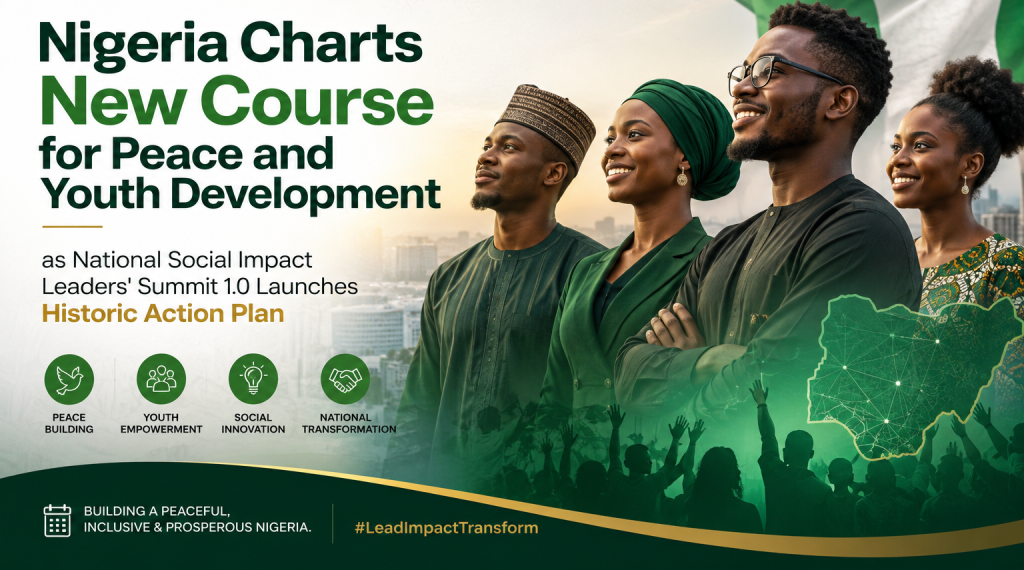
Nigeria took a significant step toward advancing youth empowerment, peacebuilding, and sustainable development as stakeholders from government, civil society, academia, the private sector, international institutions, and the media converged in Abuja for the inaugural National Social Impact Leaders’ Summit (NSILS 1.0). Held at the National Universities Commission (NUC) Conference Hall under the theme “Reimagining Social Impact: Youth, Peace, and Development in a Changing Nigeria,” the summit was convened by Ambassador Marcus Odianose Ughulu, Founder of the Marcus Odianose Ughulu Foundation for Peace and Sustainable Development (MOUFPSD), in strategic partnership with the Federal Ministry of Youth Development. The landmark event culminated in the official launch of the National Social Impact Action Plan (NSIAP) 2026–2028, a comprehensive national framework designed to mobilize stakeholders toward measurable social transformation. The summit attracted representatives from the Federal Ministry of Youth Development, National Drug Law Enforcement Agency (NDLEA), Nigerian Correctional Service, National Orientation Agency, Office of the Senior Special Assistant to the President on Sustainable Development Goals, development partners, corporate organizations including Zenith Bank, youth leaders, civil society organizations, media practitioners, and international experts.
A Call for Collective Nation Building
Delivering the welcome address, Ambassador Marcus Odianose Ughulu emphasized that Nigeria’s transformation cannot be achieved by government alone but through deliberate collaboration among citizens, innovators, youth leaders, government institutions, and development partners. He described the summit as a platform designed to move beyond conversations to practical implementation by strengthening Nigeria’s social impact ecosystem through innovation, partnerships, and accountability.
Quoting an African proverb, he reminded participants that “If you want to go fast, go alone. But if you want to go far, go together,” reinforcing the summit’s philosophy of collective responsibility for national development.
Government Reaffirms Commitment to Youth Development
Representing the Office of the Senior Special Assistant to the President on Sustainable Development Goals, Mr. Desmond Otomie highlighted the strategic importance of the Sustainable Development Goals (SDGs), particularly SDG 16, in promoting peace, justice, and strong institutions. He described Nigeria’s youthful population as one of the country’s greatest developmental assets, urging stakeholders to invest intentionally in young people through supportive policies, innovation, and strategic partnerships capable of transforming communities and driving national prosperity. Similarly, speaking on behalf of the Permanent Secretary of the Federal Ministry of Youth Development, Mr. Augustine Udoh stressed that youth empowerment remains central to addressing unemployment, insecurity, poverty, and inequality. He called for sustained investments in quality education, entrepreneurship, civic engagement, mentorship, and access to opportunities, emphasizing that young Nigerians must be viewed not merely as beneficiaries but as active architects of social change.
NDLEA Warns Against Drug Abuse
One of the summit’s major highlights was a keynote presentation by Mrs. Angela Oluchi Nweke, representing the Chairman/Chief Executive Officer of the NDLEA, Brigadier General Mohammed Buba Marwa (Rtd.). Describing drug abuse as both a public health crisis and a national security emergency, she warned that illicit drug use fuels kidnapping, banditry, violent extremism, domestic violence, and other crimes threatening national peace. She explained that the agency’s strategy combines intelligence-led enforcement with rehabilitation, prevention campaigns, counselling services, and community engagement under the War Against Drug Abuse (WADA) initiative. According to her, social impact leaders have a vital responsibility to mentor young people, create opportunities for productive engagement, and promote positive values capable of preventing youth involvement in crime and extremism.
Historic Launch of the National Social Impact Action Plan
The defining moment of the summit was the unveiling of the National Social Impact Action Plan (NSIAP) 2026–2028, described as Nigeria’s first collaborative framework dedicated to coordinating youth empowerment, peacebuilding, climate action, governance reforms, and sustainable development initiatives.
The plan is built around six strategic pillars:
1. Youth Empowerment and Economic Inclusion
2. Peacebuilding and Social Cohesion
3. Sustainable Development and Climate Action
4. Education, Health and Social Protection
5. Governance, Policy and Accountability
6. Youth Ambassadors and Voices of Peace
The implementation framework targets the empowerment of over one million Nigerian youths by 2028, expansion of green enterprises, reduction in community conflicts, stronger civic participation, and institutionalization of the National Social Impact Leaders’ Summit as an annual national platform.
Experts Advocate Innovation and Peacebuilding
Throughout the technical sessions and panel discussions, experts emphasized that sustainable peace cannot exist without inclusive development. Development practitioner Dr. Kayode Bolaji demonstrated how structural inequalities, power dynamics, and exclusion perpetuate conflict, urging participants to adopt systems built on equality, shared leadership, and mutual respect. Panelists including representatives of the National Orientation Agency, Africa Bridge Initiative, BeckyGee Foundation, Newton International Foundation, and the Nigerian Correctional Service advocated investments in skills development, digital innovation, artificial intelligence, entrepreneurship, rehabilitation programmes, affordable internet access, and stronger collaboration between government and the private sector. They argued that empowering youth economically remains one of the most effective tools for preventing violence, crime, and social instability.
International Perspective
Adding an international dimension to the summit, Professor Darren Lilleker of Bournemouth University, United Kingdom, delivered a virtual presentation on political communication, peacebuilding, and development narratives in Africa. He encouraged participants to build narratives centred on hope, unity, inclusion, and shared identity rather than division, noting that societies become stronger when citizens collectively pursue common goals through constructive public dialogue.
Stakeholders Make Historic Commitments
At the close of the summit, participants unanimously committed themselves to implementing the National Social Impact Action Plan within their respective institutions and communities. Government agencies, civil society organizations, corporate partners, youth groups, development institutions, and international stakeholders pledged to deepen collaboration, regularly monitor progress, strengthen accountability mechanisms, and sustain NSILS as Nigeria’s foremost annual platform for policy dialogue, youth engagement, and peacebuilding.
A New Chapter for Nigeria
As the curtains fell on the inaugural National Social Impact Leaders’ Summit, participants expressed optimism that the conversations initiated in Abuja would translate into concrete actions capable of reshaping Nigeria’s future. With the launch of the National Social Impact Action Plan and the commitment of stakeholders across sectors, NSILS 1.0 has positioned itself as a catalyst for national renewal; placing young people at the centre of peacebuilding, innovation, and sustainable development while laying the foundation for a more inclusive and prosperous Nigeria.
FOR IMMEDIATE RELEASE
Nigeria’s Social Impact Leaders Launch National Action Plan to Empower One Million Youths, Promote Peace and Sustainable Development
ABUJA, Nigeria – December 11, 2025; Nigeria has taken a major step toward strengthening youth development, peacebuilding, and sustainable national transformation with the successful conclusion of the inaugural National Social Impact Leaders’ Summit (NSILS 1.0), which brought together government officials, civil society leaders, development partners, private sector representatives, youth advocates, academics, and media professionals in Abuja.
Held at the National Universities Commission (NUC) Hall, Abuja, under the theme “Reimagining Social Impact: Youth, Peace, and Development in a Changing Nigeria,” the summit was convened by Ambassador Marcus Odianose Ughulu, Founder of the Marcus Odianose Ughulu Foundation for Peace and Sustainable Development (MOUFPSD), in strategic partnership with the Federal Ministry of Youth Development. The landmark gathering culminated in the official launch of the National Social Impact Action Plan (NSIAP) 2026–2028, a three-year framework designed to coordinate nationwide interventions in youth empowerment, peacebuilding, climate action, education, governance, and sustainable development.
A National Platform for Collective Action
In his welcome address, Ambassador Marcus Odianose Ughulu emphasized that Nigeria’s development challenges require collective action beyond government efforts alone. He stated that sustainable transformation depends on collaboration among government institutions, citizens, innovators, social impact leaders, businesses, and development organizations working together to create measurable solutions. “The future of Nigeria requires a shift from conversations to action,” the summit emphasized, with stakeholders encouraged to build partnerships capable of addressing youth unemployment, insecurity, social inequality, and barriers to inclusive development.
Government, Stakeholders Reaffirm Commitment to Youth Development
Representatives of government institutions highlighted the importance of placing young Nigerians at the centre of national development.
Speaking on the role of the Sustainable Development Goals (SDGs), Mr. Desmond Otomie, representing the Senior Special Assistant to the President on Sustainable Development Goals, stressed that peace, justice, and strong institutions under SDG 16 remain critical foundations for national prosperity.
He noted that Nigeria’s youthful population represents a significant opportunity for innovation and economic transformation when supported through effective policies, partnerships, and investment.
The Federal Ministry of Youth Development also called for a renewed approach to youth engagement, emphasizing that young Nigerians should not only be regarded as beneficiaries of development programmes but as active contributors and leaders in shaping the nation’s future. Representing the Permanent Secretary of the Ministry, Mr. Augustine Udoh highlighted the need for education, skills acquisition, mentorship, entrepreneurship support, and platforms for youth participation in governance and peacebuilding.
NDLEA Raises Alarm Over Drug Abuse and National Security A major focus of the summit was the impact of substance abuse on national peace and development. Representing the Chairman and Chief Executive Officer of the National Drug Law Enforcement Agency (NDLEA), Brigadier General Mohammed Buba Marwa (Rtd.), Mrs. Angela Oluchi Nweke warned that drug abuse remains a serious threat to public safety, youth development, and national stability. She explained that substance abuse contributes to crime; violence, insecurity, and social breakdown, stressing that prevention, rehabilitation, mentorship, and youth empowerment are essential components of the national response. The NDLEA representative called on social impact leaders, communities, and institutions to work together in creating positive alternatives and opportunities for young people.
National Social Impact Action Plan Targets One Million Youths The highlight of NSILS 1.0 was the launch of the National Social Impact Action Plan (NSIAP) 2026–2028, which represents a collaborative roadmap developed through contributions from government agencies, youth leaders, civil society organizations, academia, and private institutions.
The plan is structured around six strategic pillars:
1. Youth Empowerment and Economic Inclusion
2. Peacebuilding and Social Cohesion
3. Sustainable Development and Climate Action
4. Education, Health, and Social Protection
5. Governance, Policy, and Accountability
6. Youth Ambassadors and Voices of Peace
By 2028, NSIAP aims to empower more than one million Nigerian youths, support green and social enterprises, reduce community-level conflicts, strengthen civic participation, and institutionalize NSILS as an annual national platform for dialogue and collaboration.
Experts Advocate Innovation, Inclusion and Peacebuilding The summit featured keynote sessions, technical discussions, and panel conversations focused on the relationship between peace, innovation, economic opportunity, and sustainable development.
Experts emphasized that unemployment, exclusion, and limited opportunities remain major drivers of social instability, calling for increased investment in digital skills, entrepreneurship, artificial intelligence, renewable energy, rehabilitation programmes, and inclusive economic opportunities. Representatives from organizations including the National Orientation Agency, Nigerian Correctional Service, Africa Bridge Initiative, BeckyGee Foundation, and Newton International Foundation highlighted the need for stronger partnerships between government, private sector actors, and communities.
Global Perspective on Peace Narratives The summit also featured an international presentation by Professor Darren Lilleker of Bournemouth University, United Kingdom, who addressed political communication, public dialogue, and development narratives in Africa.
Professor Lilleker encouraged stakeholders to promote narratives built around unity, hope, inclusion, and shared identity, noting that strong societies emerge when citizens engage constructively around common goals. Stakeholders Commit to Sustained Collaboration At the conclusion of the summit, participating organizations committed to implementing the recommendations of NSILS 1.0, supporting the National Social Impact Action Plan, and strengthening collaboration across sectors. Stakeholders also agreed to maintain continuous engagement, monitor progress, and support the institutionalization of NSILS as an annual platform for advancing youth leadership, peacebuilding, and sustainable development in Nigeria.
About NSILS
The National Social Impact Leaders’ Summit (NSILS) is a national platform established to promote collaboration, policy dialogue, innovation, and strategic action around youth empowerment, peacebuilding, and sustainable development. The summit is convened by the MARCUS ODIANOSE UGHULU FOUNDATION FOR PEACE AND SUSTAINABLE DEVELOPMENT (MOUFPSD), with a mission to strengthen cross-sector collaboration and drive actionable solutions for a peaceful, inclusive, and sustainable Nigeria. Media
Contact: Marcus Odianose Ughulu Foundation for Peace and Sustainable Development (MOUFPSD) Email: moufpsd@gmail.com NSIAP Partnership Inquiries: mfintegratedservices@gmail.com

